See exactly where the sun hits your roof
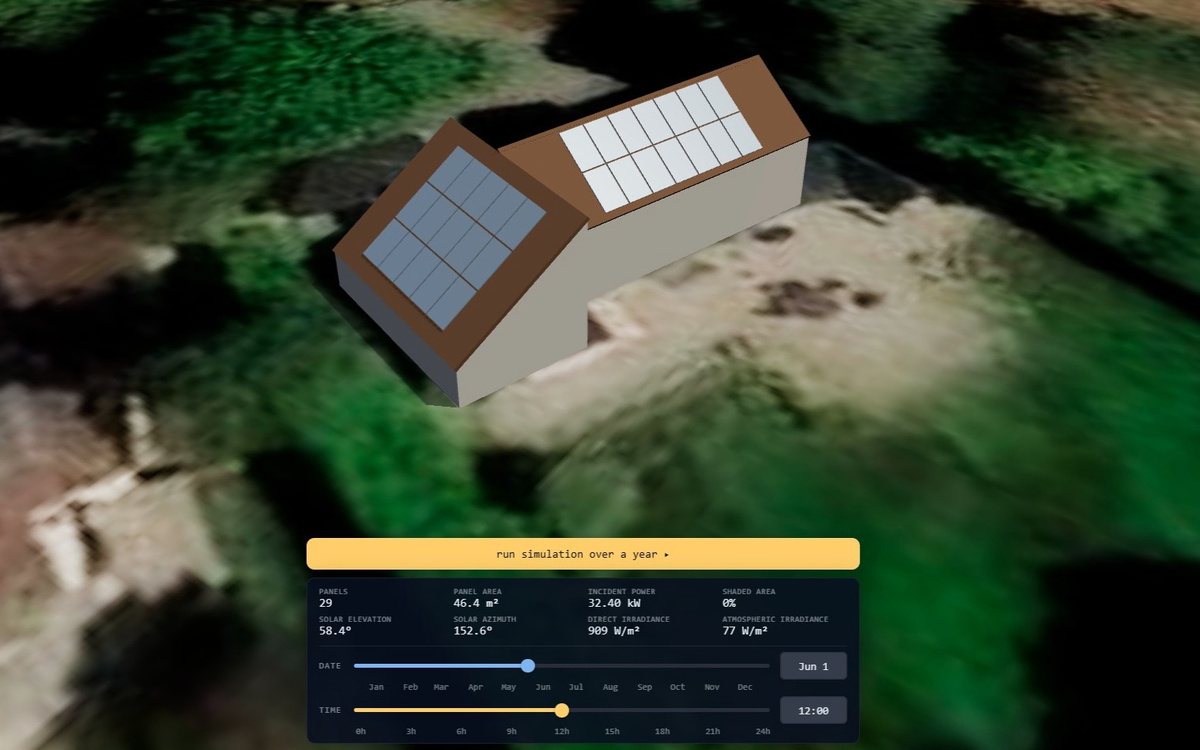
A free 3D solar panel shadow simulator. Trace your roof over satellite imagery, lay out panels, and watch real shadows move across them through the day and across the year — so you know what a chimney, a building or the neighbour's tree actually costs you.
Launch the simulator Free · No signup · Runs in your browser
How it works
-
Find your address
Search any location in the world. Satellite imagery drops in underneath as a tracing guide, and the latitude and time zone are set for you so the sun is in the right place.
-
Build your roof and surroundings
Size the building, set the roof pitch and orientation, then add the things that cast shadows — trees, chimneys, neighbouring buildings. Or skip the roof entirely and lay panels out on open ground.
-
Move the sun
Scrub through the day and watch shadows sweep across the array in real time. Jump to the winter solstice to find your worst case, or run the full year hour by hour to get annual totals.
What you can work out
Where shading really bites
Low winter sun throws long shadows that never appear in a summer site visit. Seeing the whole year tells you whether a row is a good idea or a permanent liability.
The best place for each panel
Per-panel figures show which positions pull their weight and which sit in shadow half the winter, so you can move or drop them before anything is bolted down.
What an obstruction costs
Every run is compared against the same array with all shadows removed, giving you the shading loss as a straight percentage. Useful when deciding whether that tree comes down.
Whether the layout is worth it
Compare orientations, tilts and row spacings against each other on annual totals rather than on intuition or a rule of thumb.
Frequently asked questions
Will a tree shade my solar panels?
That depends on its height and position, and it changes hour by hour and month by month. Place an obstruction at the right spot and height, then scrub the sun to see precisely when its shadow crosses the array and what that costs you.
How much do shadows reduce solar output?
More than the shaded area alone suggests. Shading part of a panel can disproportionately cut that panel's output, and depending on wiring the loss can spread across a string. Sun Sandbox reports optical shading loss by comparing your array against the identical array with every shadow removed, so you see the cost of a specific obstruction rather than guessing at it.
Which way should solar panels face?
In the northern hemisphere, south-facing collects the most annual sunlight; in the southern hemisphere, north-facing. But orientation interacts with pitch, latitude and nearby shading, so the best real answer is often not the textbook one. Try orientations against your actual roof and compare annual totals.
Is it free?
Yes — free, no account, no signup. The simulation runs entirely in your browser and nothing about your roof is uploaded to a server.
How accurate is it?
Sun position is astronomically accurate for the date, time and coordinates you pick, and shadow geometry is exact for the shapes you draw. Irradiance uses an idealised clear-sky model, so absolute figures run higher than measured weather data. Comparisons between layouts are the trustworthy part.
Does it calculate output in kWh?
Not directly. Figures are optical power on the panel surface, with no module efficiency or inverter loss applied. Multiply incident energy by your module efficiency and system losses for an approximate electrical figure.
Try it on your own roof
It opens straight into a 3D scene. Nothing to install, nothing to sign up for.